
“Journalism is an act of faith in the future”
Ann Curry
In this post of my blog I am going to explain how the digital economy has changed the journalism sector and to examine from an analytical point of view what the future of the profession will be like under the influence of digital environment. I have worked most of my short career in this area, from reporter to editor. So, I think that I can reflect my concerns about this subject in an accurate way.
I have the feeling that in recent years journalism, as it was originally conceived, has suffered one of the most radical changes in terms of professions. Moreover, I would say that since the creation of the first newspaper in 1594, the Mercurius Gallobelgicus (Fletcher, 2014, p. 3), there has not been a more disruptive event. That first change of channel, from oral to written transmission, has been renewed with its 2.0. version: print newspapers to the digital newspapers.

This irruption into the online world has created certain ambivalence between the public and professionals. There is no doubt that new technologies have become great allies, but also great enemies with which the professional must deal with every day. Digital journalism has changed the information paradigm, since it provides a broader and more pluralistic range; something essential for any democratic society. The current journalist must face four major challenges:
Immediacy
Selection procedure
Quality
Capital
The arrival of the digital age is making the human being becoming the homo ipso facto: everything must be done quickly. Therefore, the journalist must incorporate this new need with other principles of traditional journalism, such as the rigour and contrast of information, where the “time factor” is fundamental. The chance that digital environment gives millions of sources without hardly any effort makes the news reader tend not to read the full articles. In fact, 55% of digital readers spend less than 15 seconds on each news article (Hayle, 2014). Moreover, digital media has changed the system. Before, the journalist selected the news that he/she considered interesting for the reader. However, now the reader has the option to use their criteria when choosing. This liberalization, combined with the profusion of the digital environment, has led to a greater diversity of sources (mainly scattered in Social Media) that in most cases are little contrasted. Thus, the result is misinformation.
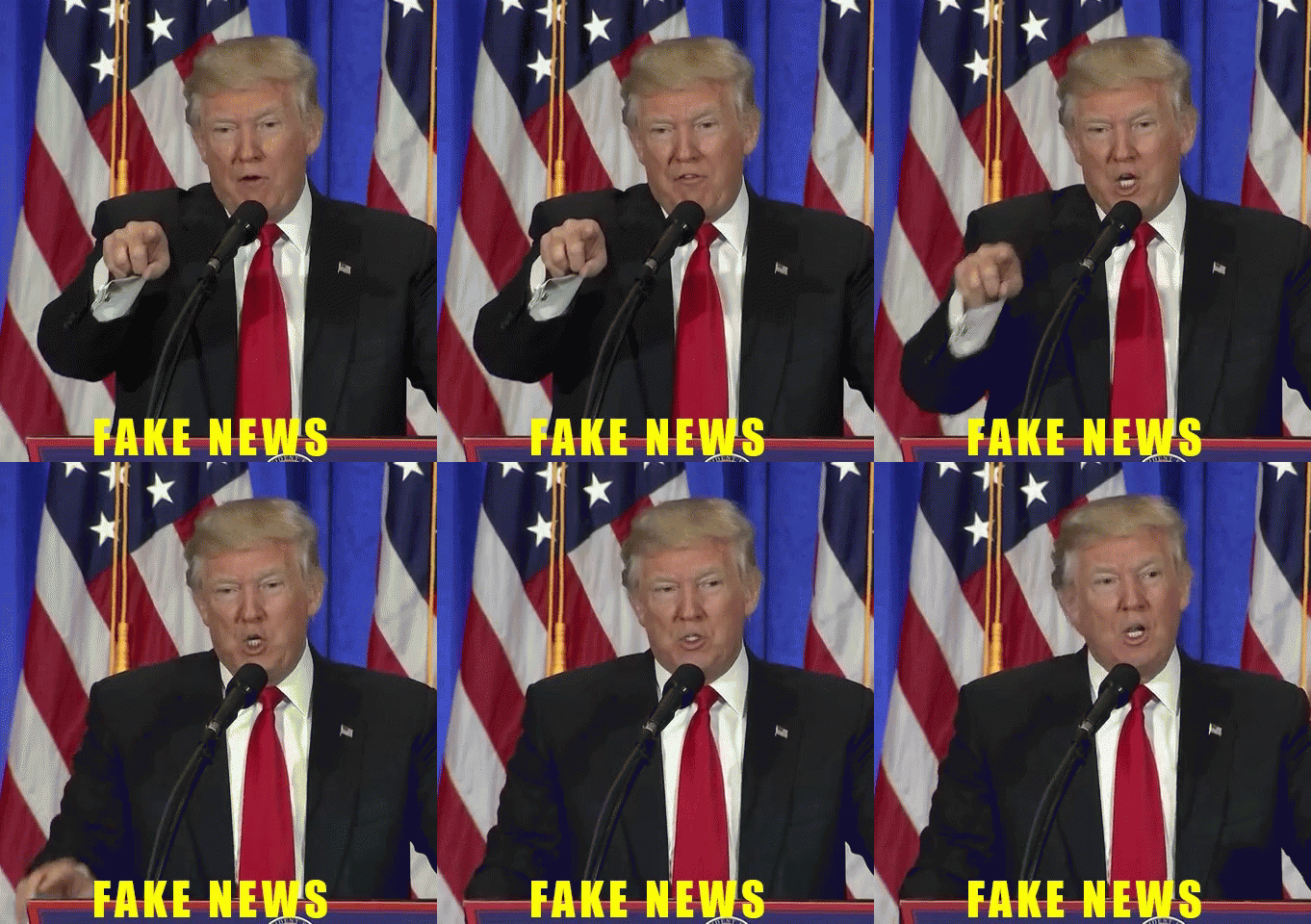
Ironically, the most fashionable term in 2017 is involved: Fake News.
With this scenario, there is a factor that makes the difference: quality. Digital media has diminished the quality of the product by this lack of maturation that I mentioned before. Consequently, it is interesting to see how the journalistic style is changing. The creation of journalistic niches in which the product is treated in a more careful way is progressively increasing. As Filloux (2013) pointed out, “magazines have done a lot better job than newspapers capturing readers’ preferences”. This is presumably visible in the average reader, who can recognize a certain rejection of the most outdated standards of journalistic writing and be attracted by the more rejuvenated journalism showed in magazines.
Is immediacy the only culprit in the decline of quality?
Absolutely not, the main reason is money. We are all used to neologisms like clickbait. The new route that the profession is taking goes round a rugged road where the headline is more important than the content and where the importance of the news is measured not by its journalistic value, but its profitability.
How will the situation change in the future?
I think the situation of journalism as we know will change a lot in the coming years. Print newspapers will hardly survive over the years (Sambrook, 2017), with exceptions to certain market niches, such as exclusive cultural magazines. Subscription systems will be more widespread than now (Gingras, 2018) and the personal value of each brand will play a crucial role in gaining readers. Unfortunately, the essay articles will lose strength due to the lack of focused reading of the clients. Although my point of view is somewhat pessimistic, I think the solution will be brought by the readers themselves. We must put more effort in selecting and contrasting the information we read. If we know that there are vested interests in the news, we should suspect. Here I attached a video in which the renowned journalist Nandagopal Rajan gives useful advice on how to fight against misinformation.
If you want to know more about this topic, click here
to learn how to fight disinformation!
In short, having worked as a journalist and considering myself an avid reader of newspapers, I understand that immediacy is something desirable in the media. Nevertheless, it should not become its main objective, since it leads to errors that destroy the main values of journalism: credibility and trust. If we manage to use the digital resources appropriately, we will have an excellent tool for the propagation of news.
Word count – 825
References
Filloux, F. (2013), We Need a New Era of Digital Journalism. The Guardian. Retrieved from: https://www.theguardian.com/technology/2013/feb/18/digital-media-internet
Fletcher, P. (2014), News in Early Modern Europe: Currents and Connections. Brill, p. 3.
Flood, A. (2017), Fake news is ‘very real’ word of the year for 2017. The Guardian. Retrieved from: https://www.theguardian.com/books/2017/nov/02/fake-news-is-very-real-word-of-the-year-for-2017
Gingras, R. (2018), How Journalism can thrive in the digital age. The Star. Retrieved from: https://www.thestar.com/opinion/contributors/2018/06/21/how-journalism-can-thrive-in-the-digital-age.html
Hayle, T. (2014). What You Think You Know About the Web Is Wrong. Time magazine. Retrieved from: http://time.com/12933/what-you-think-you-know-about-the-web-is-wrong/
Rajan, N. (2017), Online Journalism and The New Rules of The Game. TEDx Talks [Video file]. Retrieved from: https://www.youtube.com/watch?v=aa00673C9-o
Sambrook. R (2017), Stop Press? Last Words on the Future of Newspapers. Independent. Retrieved from: https://www.independent.co.uk/arts-entertainment/stop-press-last-words-on-the-future-of-newspapers-a7558006.html
Vongkiatkajorn, K. (2018), Here’s How You Can Fight Back Against Disinformation. Mother Jones. Retrieved from: https://www.motherjones.com/media/2018/08/heres-how-you-can-fight-back-against-disinformation/


 Cesar MarKtin